
“He who has a why to live can bear almost any how.” – Friedrich Nietzsche
Men often pride themselves on being hard-working, resilient, and able to “push through.” But when fatigue, low mood, or irritability become constant companions, the line between burnout and depression can blur. Recognising the difference isn’t just about productivity — it could be life-saving.
1. Why this matters
We all want and should have access to quality medical care, regardless of gender, race, or beliefs. People from all walks of life can fall victim to mental illness, which is real. These stats suggest men in Australia face some of the highest rates of lethal suicide: Men in Australia face some of the highest rates of lethal suicide. According to the Australian Bureau of Statistics (ABS, 2022), men accounted for 76% of all deaths by suicide in 2022 — that’s 2,455 men, compared to 794 women, out of a total of 3,249 suicides ABS Causes of Death, Australia, 2022
Having a low threshold to talk with your GP is crucial. A 15-minute conversation can literally change the trajectory of your health.

2. Burnout or depression: what’s the difference?
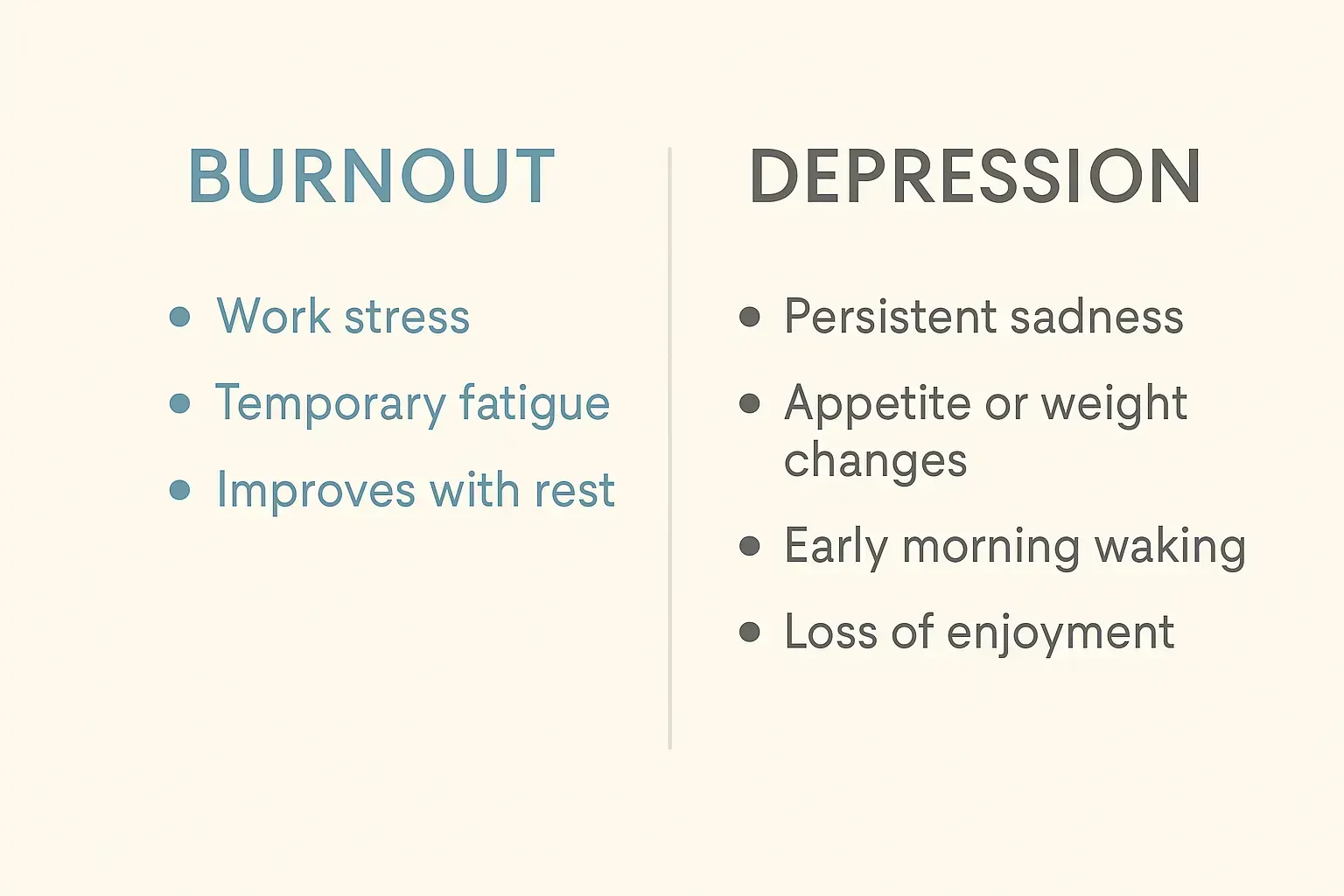
Burnout is typically linked to chronic stress at work. It shows up as exhaustion, cynicism, and reduced performance. It usually improves with rest, boundaries, or changes in workload.
Depression goes deeper. It’s not just stress - it’s a neurobiological condition. Warning signs include:
- Loss of appetite or significant changes in weight
- Waking early in the morning without being able to get back to sleep
- Not enjoying activities you normally would
- Difficulty concentrating
- Past history of head injury
- Persistent sadness, hopelessness, or withdrawal
These symptoms don’t resolve with a weekend off. They’re red flags that you need proper medical support.
Are your symptoms lifting with rest, or are they sticking around no matter what you try?
3. Listen to your mates and your family
Sometimes your friends, partner, or family notice changes before you do — like snapping at small things, avoiding social catch-ups, or drinking more than usual. Their perspective matters. If multiple people who care about you are saying “You don’t seem yourself,” take that seriously.

4. Holistic solutions (not just Western medicine)
Not every answer comes in a pill bottle. Exercise, better sleep routines, mindfulness, or even reconnecting with hobbies like surfing or music can all help.
That said, a chat with your GP never hurts. Even if you want to try natural or lifestyle approaches, your doctor can help rule out medical issues such as thyroid disease, testosterone imbalance, or consequences of previous head trauma.

5. Professional and personal perspective
As a GP registrar and researcher, I’ve seen how burnout and depression creep up on men who look “successful” from the outside — thriving careers, big incomes, busy families. Personally, I’ve had to check in with myself and my own GP when stress pushed me close to the edge. That humility makes me better placed to encourage others: you’re not weak for reaching out, you’re smart.

6. When to check in with your GP
You feel flat, hopeless, or irritable most days for more than two weeks
You’ve lost weight or appetite without trying
You’re waking early in the morning and can’t get back to sleep
You’ve stopped enjoying activities you normally love
You have a history of head injuries
Friends or family keep telling you they’re worried
Work performance or relationships are suffering
You’ve had thoughts of suicide or self-harm
Don’t wait. Call your GP today. And if it’s urgent, call Lifeline on 13 11 14 in Australia.
7. Early intervention saves lives
The most important difference between burnout and depression is what happens if you don’t act. Burnout may fade if you set boundaries or change workload. Depression does not usually resolve on its own — and left unchecked, it can spiral into major health risks. Research consistently shows that early treatment of depression improves recovery rates and reduces the risk of relapse. The sooner you check in with your GP, the more options you’ll have, from lifestyle changes to counselling to medical support if needed.
If you had chest pain, would you wait weeks to get checked? So why wait with your mental health?
This isn’t about choosing between burnout or depression as a label. It’s about recognising when you’re not okay — and having the courage to talk about it.
👉 follow me on socials for straightforward men’s health advice.
Disclaimer: This article is for general information only. It is not personalised medical advice. Always consult your GP before making health decisions.
Source: Australian Bureau of Statistics (2023). Causes of Death, Australia, 2022. Cat. no. 3303.0. Canberra: ABS. Available at https://www.abs.gov.au/statistics/health/causes-death/causes-death-australia/latest-release.




0 comments